Key Takeaways:
• Workplace dehydration is not only a safety risk; it can also create a hidden productivity and performance cost across every shift.
• Research has shown that mild dehydration can increase errors, reduce attention and impair working memory, motor coordination and physical work capacity.
• Workers may begin to slow down or make more mistakes before they consciously feel thirsty.
• Productivity losses are often hidden because they appear as presenteeism, slower task completion, rework, fatigue, errors or reduced work pace rather than a reportable incident.
• WHS and operations teams can use hydration education, pre-start prompts, environmental heat monitoring, fluid and electrolyte access, and screening tools to identify and reduce dehydration-related performance risk.
Dehydration is also a productivity problem
Walk through most Australian heavy-industry sites today and you will find a health & safety response to workplace dehydration: pre-start reminders, urine colour charts, electrolyte and water stations, heat stress protocols. That investment is important and has saved lives.
It has also created the impression that workplace dehydration is just a safety problem. It is also a productivity and performance problem. In dollar terms, this is significantly larger. It is paid for every shift, whether or not a safety incident occurs.
In a previous article we showed that across six Australian studies, more than half of heavy-industry workers arrived at work already dehydrated.
This article explores the cost of dehydration. What the research tells us. How much it costs if a worker walks through the site gates already dehydrated. How to size the cost for your own operation. How to spot it in metrics you already collect - and five things worth doing about it on Monday.
Twice the errors: The cost of mild dehydration
In 2015, researchers at Loughborough University in the UK ran a study. Eleven healthy young men completed a two-hour driving simulator task on two occasions: once well-hydrated, and once after their fluid intake was restricted to produce only mild dehydration.
The number of driver errors in each condition: 47 hydrated, 101 mildly dehydrated.
The error types were similar to ones that matter on a mine or heavy-industry site: lane drifting, late braking and crossing centreline markings.
The authors estimated that the size of the decline was similar to what has been reported at a blood alcohol level of around 0.08%. The Australian legal driving limit is 0.05%.
No operation in Australia would knowingly let a worker drive over the legal alcohol limit. Yet this study shows that mild dehydration can more than double driving errors in a controlled simulator task.
Importantly, this was a dehydration-only experiment. Heat was not added to the study. The increase in errors came from mild dehydration alone.
How dehydration affects workers
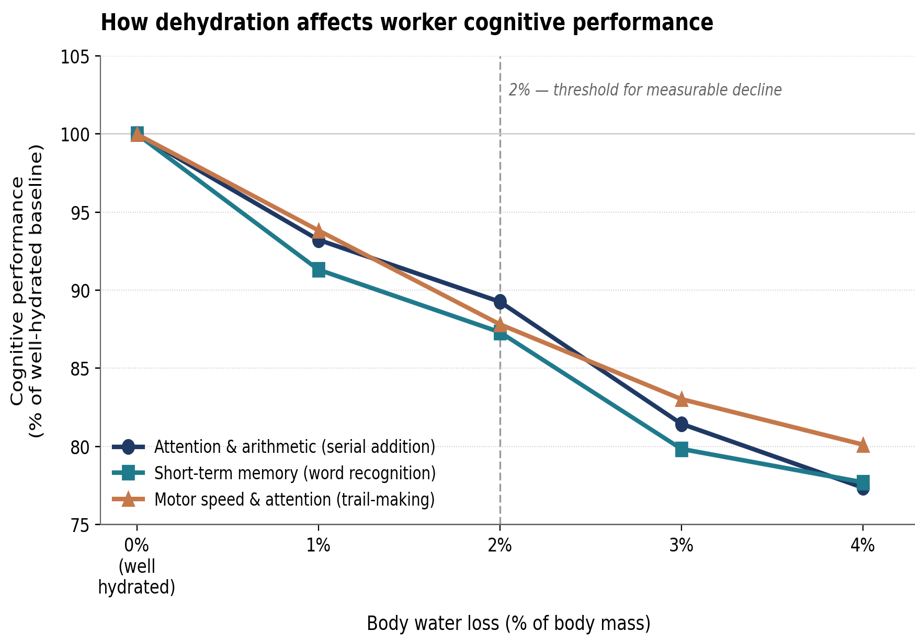
To put this in perspective, a 70 kg worker reaches 2% body water loss after losing 1.4 L of fluid without replacement. That is easily reached in three to four hours of moderate work. By the time the worker feels thirsty, the productivity loss is already happening.
The chart below shows what this looks like in practice. In the research study below (Gopinathan et al, 1988) workers were tested on three cognitive measures across progressive levels of dehydration. Performance falls measurably at 2% body water loss. By 4%, two of the three measures had dropped to around 80% of the well-hydrated baseline.
The impact on performance
Across laboratory studies, controlled crossover trials and occupational simulations, the same pattern emerges: workers start slowing down and making more errors before they realise they are dehydrated. The effect intensifies above 2% body water loss and amplifies further in heat.
Study results are summarised in the table below - from staged dehydration trials to a meta-analysis that reviewed 33 studies and 413 subjects. Overall they show consistent findings on the impact on cognitive performance and physical work capacity - including in Australian occupational settings.
The flow on impact to productivity
This performance decline has a direct impact on productivity cost. A large study of over 1,200 respondents calculated that Australian workers affected by heat-related dehydration (around 70% of those surveyed) lose, on average, about 27 hours of productive work per year - adding up to a national economic cost of approximately AUD 6.9 billion per year*. Dehydration was identified as the main driver (Zander et al. 2015).
* USD 6.2 billion in the original 2015 study
The figures almost certainly understate the total. Most operations do not track presenteeism (workers showing up but underperforming), which is where the majority of the dehydration cost sits, largely invisible to the operational scorecard.
In the table below five separate studies quantify the costs.
Heat amplifies the cost
Working in the heat amplifies the impact of dehydration. Once skin temperature exceeds about 27°C, dehydration begins to affect physical performance. Sawka et al. (2015) reported an additional +1.5% physical decline for every additional 1°C rise in skin temperature.
Where to look for it in your own operation
Dehydration productivity loss is hidden inside metrics you already collect, but rarely in a line item you would expect. It does not arrive as a single recordable event. It arrives as a small percentage missing from operational benchmarks, spread across hundreds of workers and thousands of shift-hours.
If three or more of the following are true on your operation, the cost is being paid and likely not being counted:
- End-of-shift output dips relative to start-of-shift, and the dip is worse on hot days.
- Operational performance numbers consistently lower in summer than winter, without an obvious mechanical cause.
- “The weather” is used as an informal explanation for missed targets, without ever being quantified.
- Late-shift error rates, rework rates or minor incident rates are higher than early-shift rates.
- Workers are taking longer rest than scheduled, especially in afternnons.
- Fatigue management metrics worsen seasonally without a change in roster pattern.
- Workers say they “feel fine” at toolbox talks while output metrics quietly slide.
The last point is very important. Workers typically find it difficult to identify mild dehydration - they cannot self-correct what they cannot measure.
Five actions to implement on Monday
The interventions that recover this productivity loss overlap with many existing WHS controls. The productivity framing changes who needs to care and what the business case looks like.
1. Redesign work around peak heat, not just shift start times.
Where possible, move heavier work earlier, rotate high-exertion tasks, reduce exposure during peak heat and build acclimatisation into hot-season planning. A 2021 review (Morrissey et al.) reports that moving a working shift two hours earlier to avoid peak heat reduces heat-related cost by approximately 33%.
2. Make cooling, water and breaks operational controls, not optional behaviours.
Build shade, cool rest areas, drink breaks and ready access to cool drinking water into the work plan. Safe-work guidance consistently treats rest, shade/cooling and fluid access as core heat-risk controls, not “nice to have” welfare measures. For long, hot or high-sweat shifts, sites should also have a clear approach to providing electrolyte replacement options.
3. Move the hydration intervention before the shift starts.
Worksite measures cannot fully reverse a deficit created off-site. Pre-shift hydration is where a large recoverable productivity loss may already be sitting - before the worker reaches the site gate.
4. Give workers a hydration feedback loop.
Workers cannot always identify mild dehydration. A pre-shift hydration test, that returns a result the worker can easily understand and act on, closes the loop between risk, behaviour and action.
5. Make dehydration-related productivity loss visible on the operations dashboard.
Until dehydration-attributable productivity variance has a line on the operational scorecard, it will continue to be absorbed into general variance and attributed to weather, terrain or “a bad day.”
The key takeaway
Workplace dehydration is costing your operation money on every shift it occurs. Workers can't feel mild dehydration - they're already slowing down and making more errors before they know it.
The research base is mature and includes substantial Australian workplace studies. The interventions exist. The most underused is also one of the most powerful - catch and address dehydration before workers step onto the site.

References
- Asare BYA, Makate M, Powell D, Kwasnicka D, Robinson S. Cost of health-related work productivity loss among fly-in fly-out mining workers in Australia. International Journal of Environmental Research and Public Health. 2022;19(16):10056.
- Cvirn MA, Dorrian J, Smith BP, Vincent GE, Jay SM, Roach GD, Sargent C, Larsen B, Aisbett B, Ferguson SA. The effects of hydration on cognitive performance during a simulated wildfire suppression shift in temperate and hot conditions. Applied Ergonomics. 2019;77:9–15.
- Flouris AD, Dinas PC, Ioannou LG, Nybo L, Havenith G, Kenny GP, Kjellstrom T. Workers' health and productivity under occupational heat strain: a systematic review and meta-analysis. The Lancet Planetary Health. 2018;2(12):e521–e531.
- Gopinathan PM, Pichan G, Sharma VM. Role of dehydration in heat stress-induced variations in mental performance. Archives of Environmental Health. 1988;43(1):15–17.
- Morrissey MC, Brewer GJ, Williams WJ, Quinn T, Casa DJ. Impact of occupational heat stress on worker productivity and economic cost. American Journal of Industrial Medicine. 2021;64(12):981–988.
- Sawka MN, Cheuvront SN, Kenefick RW. Hypohydration and human performance: impact of environment and physiological mechanisms. Sports Medicine. 2015;45(Suppl 1):S51–S60.
- Wästerlund DS, Chaseling J, Burström L. The effect of fluid consumption on the forest workers' performance strategy. Applied Ergonomics. 2004;35(1):29–36.
- Watson P, Whale A, Mears SA, Reyner LA, Maughan RJ. Mild hypohydration increases the frequency of driver errors during a prolonged, monotonous driving task. Physiology & Behavior. 2015;147:313–318.
- Wittbrodt MT, Millard-Stafford M. Dehydration impairs cognitive performance: a meta-analysis. Medicine & Science in Sports & Exercise. 2018;50(11):2360–2368.
- Zander KK, Botzen WJW, Oppermann E, Kjellstrom T, Garnett ST. Heat stress causes substantial labour productivity loss in Australia. Nature Climate Change. 2015;5(7):647–651.